Exception Handling in Async C# Methods
Exceptions Don’t Stay Where They Started
In the previous part, we learned how continuations carry the method forward after an await. This part deals with what happens when something inside that chain goes wrong. The short answer: exceptions still propagate, but they travel through the task and arrive at the await point - not at the throw site.
Miss this distinction once and you’ll spend an afternoon staring at a stack trace that points nowhere useful.
How Exceptions Travel Through Tasks
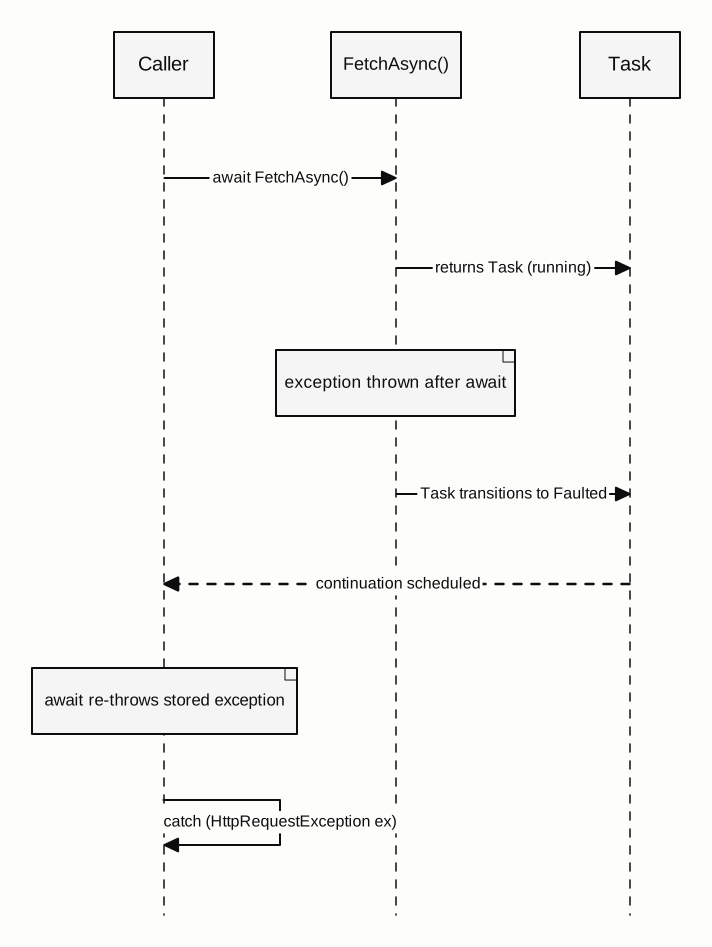
The state machine - the compiler-generated struct that drives every async method - catches all exceptions that escape the method body and stores them on the returned Task. The task transitions to the Faulted state. Nothing is thrown at the call site yet.
When a caller awaits that faulted task, the stored exception is re-thrown at the await point. A try/catch around the await will catch it, just as it would in synchronous code - with one important difference: the stack trace reflects where the exception was rethrown (at the await), not where it originally occurred. In .NET 4.5 and later, the original stack trace is preserved where possible through ExceptionDispatchInfo.
private async Task<string> FetchAsync(string url)
{
    using var http = new HttpClient();
    // If GetAsync throws (network error, DNS failure, etc.),
    // the exception is stored in the returned Task.
    var response = await http.GetAsync(url);
    response.EnsureSuccessStatusCode();
    return await response.Content.ReadAsStringAsync();
}

// Caller:
try
{
    var data = await FetchAsync("https://api.example.com/data");
    Display(data);
}
catch (HttpRequestException ex)
{
    ShowError($"Network error: {ex.Message}");
}
catch (Exception ex)
{
    Log(ex);
    ShowError("An unexpected error occurred.");
}
The exception surfaces at await FetchAsync(...), not inside FetchAsync itself. Catch it there, at the await point where you have the right context to handle it (Figure 1).
Exception propagation — stored in Task, re-thrown at the await point:
Exceptions before the first await
There’s a nuance worth knowing. In an async method, even an exception thrown before any await is technically stored in the returned Task - because the compiler wraps the entire method body in a try/catch inside MoveNext(). This means argument validation at the start of an async method doesn’t throw synchronously at the call site; it produces a faulted task.
For library code where you want argument exceptions to throw immediately - before the caller even has a chance to await - separate the public method from the async implementation:
// Public method: validates synchronously
public Task<string> FetchAsync(string url)
{
    ArgumentNullException.ThrowIfNull(url, nameof(url));
    return FetchCoreAsync(url);  // delegate to private async core
}

// Private async core: does the real work
private async Task<string> FetchCoreAsync(string url)
{
    using var http = new HttpClient();
    var response = await http.GetAsync(url);
    return await response.Content.ReadAsStringAsync();
}
This pattern is rare in application code but valuable in reusable APIs where the caller should fail fast on bad input.
The async void Trap
async void is the exception that causes crashes. Literally.
When an async void method throws after an await, there’s no Task to store the exception in. It has nowhere to go. The exception is posted to the current SynchronizationContext’s unhandled exception handler. In most app hosts, that terminates the process.
// This will crash the application - no Task, nowhere to catch it
async void DoSomethingUnsafe()
{
    await Task.Delay(500);
    throw new Exception("No one will catch this.");
}

// The caller can't protect itself
DoSomethingUnsafe();  // fire and forget - but also: crash and burn
The only legitimate use for async void is event handlers, where the framework requires a void signature. Even there, wrap the body in a try/catch:
private async void SaveButton_Click(object sender, RoutedEventArgs e)
{
    try
    {
        await SaveDocumentAsync();
        StatusLabel.Text = "Saved.";
    }
    catch (IOException ex)
    {
        StatusLabel.Text = "Save failed - check your disk.";
        Log(ex);
    }
    catch (Exception ex)
    {
        StatusLabel.Text = "An unexpected error occurred.";
        Log(ex);
    }
}
In .NET 4.0, unobserved task exceptions - exceptions stored in a Task that was never awaited or observed - would terminate the process via TaskScheduler.UnobservedTaskException. This was changed in .NET 4.5: unobserved task exceptions are silently swallowed by default. This is safer but can hide real bugs. If you fire a task without awaiting it, any exception it throws will silently disappear unless the task’s Exception property is read or TaskScheduler.UnobservedTaskException is subscribed to.
.Result, .Wait(), and .GetAwaiter().GetResult()
All three synchronously block on an async task. None of them belong in general async code.
The first problem is exception wrapping. Where await re-throws the original exception, .Result and .Wait() wrap it in an AggregateException:
// With .Result: exception is wrapped
try
{
    var result = FetchAsync().Result;
}
catch (AggregateException ex)
{
    var real = ex.InnerException;  // have to unwrap
}

// With await: original exception type preserved
try
{
    var result = await FetchAsync();
}
catch (HttpRequestException ex)
{
    // Caught correctly - no unwrapping needed
}
.GetAwaiter().GetResult() avoids the AggregateException wrapping, but it still blocks and still risks deadlocks.
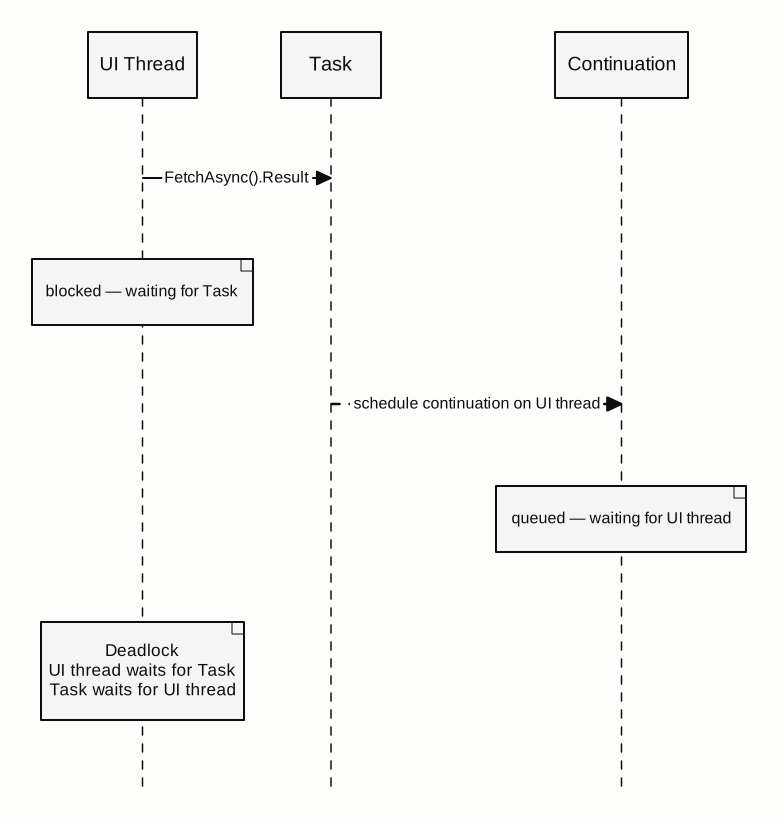
The second problem is deadlock. In a context-bound environment (WPF, WinForms, ASP.NET Framework), the continuation is scheduled to run on the UI or request thread. If you block that same thread with .Result, neither can proceed: the thread waits for the continuation, and the continuation waits for the thread. The application hangs (Figure 2).
The rule is simple: in async code, use await. Not .Result. Not .Wait(). Not .GetAwaiter().GetResult() on a context-bound thread.
Deadlock — blocking on a Task that needs the current thread:
Handling Multiple Tasks
Task.WhenAll runs multiple tasks concurrently and waits for all of them. When one or more fail, it throws only the first exception when awaited. The remaining exceptions are stored on the returned task’s Exception.InnerExceptions collection.
var userTask   = FetchUserAsync(userId);
var ordersTask = FetchOrdersAsync(userId);

try
{
    await Task.WhenAll(userTask, ordersTask);
}
catch (Exception)
{
    // This is only the first exception.
    // Inspect each task directly to capture all failures:
    if (userTask.IsFaulted)
        HandleError("user fetch", userTask.Exception!.InnerException!);

    if (ordersTask.IsFaulted)
        HandleError("orders fetch", ordersTask.Exception!.InnerException!);
}
If you need to process all exceptions, inspect each faulted task individually after Task.WhenAll throws - don’t rely solely on the caught exception.
Cancellation Is Not a Failure
OperationCanceledException occupies a special place in the async exception model. It’s not a sign that something went wrong - it’s the signal that work was deliberately stopped. Treat it as expected flow, not as an error.
public async Task LoadAsync(CancellationToken cancellationToken)
{
    try
    {
        var data = await GetDataAsync(cancellationToken);
        Render(data);
    }
    catch (OperationCanceledException) when (cancellationToken.IsCancellationRequested)
    {
        // Expected: caller stopped the operation
        // No logging needed, no error UI required
    }
    catch (Exception ex)
    {
        // Real errors: log and report
        ShowError("Failed to load.");
        Log(ex);
    }
}
The when (cancellationToken.IsCancellationRequested) guard is precise: it catches OperationCanceledException only when your cancellation token was the cause - not when a different library cancels for its own reasons inside the same call chain.
Quick Reference: Async Error Handling Rules
awaitre-throws original exceptions with full type information. Wrap it intry/catchwhere you expect failures.async voidevent handlers: wrap the entire body intry/catchor exceptions will crash the process.- Never block with
.Resultor.Wait()in an async call chain. - After
Task.WhenAll, check each individual faulted task to capture all exceptions. - Catch
OperationCanceledExceptionseparately and treat it as normal completion.
Async exceptions travel through the task chain and surface at the await point. Once you expect that, the catch site feels obvious — it’s the same place you’d handle any other failure in the calling code.
In the next part, we’ll look at how to design async methods that communicate clearly about their completion, their failures, and their intent - so callers can depend on them without guessing.